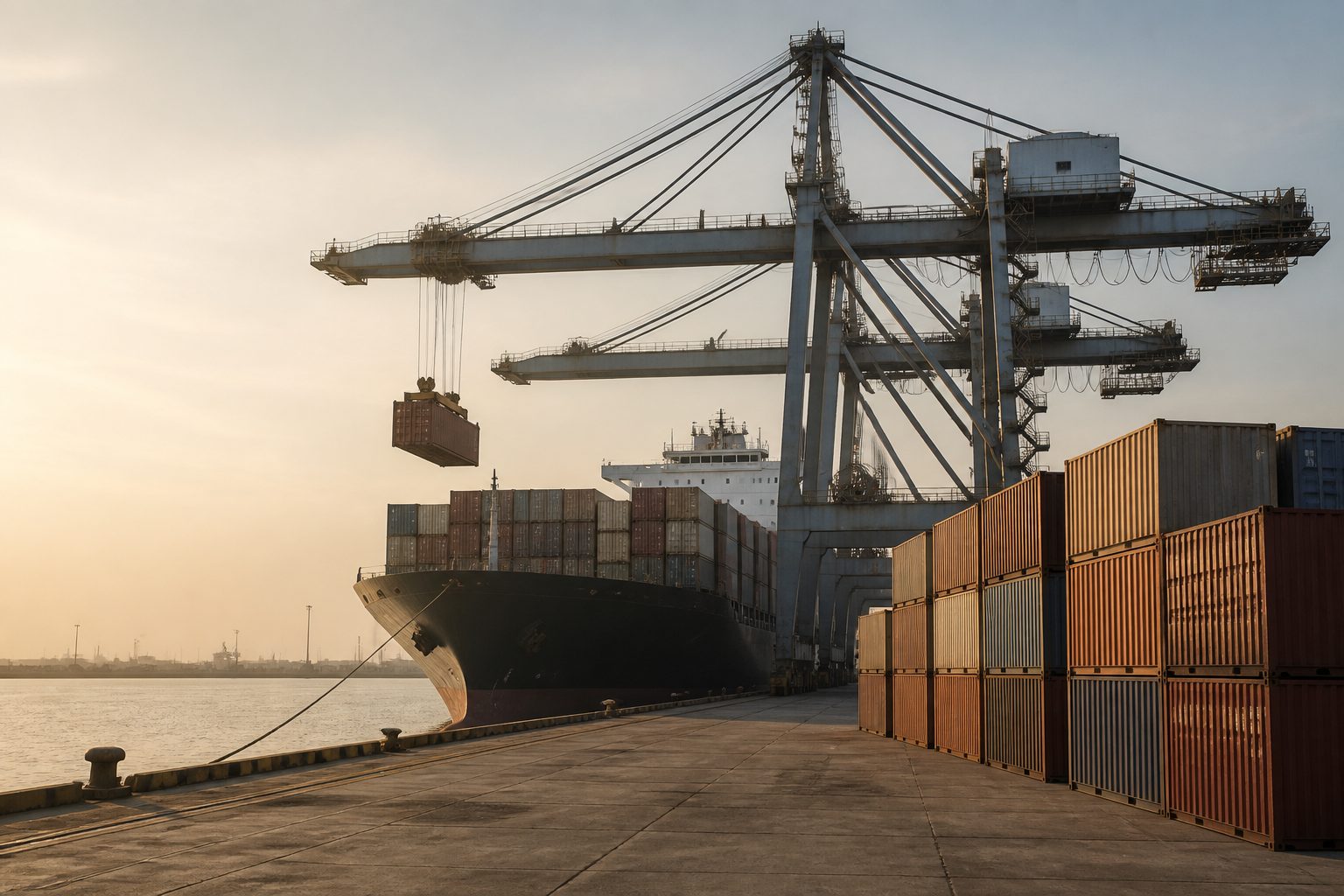
Importing from China to Pakistan means paying a stack of charges calculated on the CIF value of your goods — customs duty under the First Schedule, a flat 2% additional customs duty, regulatory duty wherever an SRO imposes it, sales tax on the duty-paid value, and withholding income tax under Section 148 — and then clearing the consignment through the Pakistan Single Window with an NTN, a linked authorised-dealer bank profile and a correct eight-digit HS code. The headline customs duty rate is only the first of those layers, and it is the layer the China-Pakistan Free Trade Agreement Phase II can reduce most — but the concession is claimed with the goods declaration, so a valid FTA certificate of origin has to travel with the shipment. Claim it late and the difference is gone.
The rest of this guide covers how the duty stack compounds, how the FTA concession actually works, what you must register before your first container sails, the exchange-control side of paying a Chinese supplier, and the routes and transit times from Chinese ports into Karachi.
Why Pakistan is a different import market in 2026
China is Pakistan’s largest source of imports by a wide margin, supplying machinery, electronics, chemicals, raw materials and consumer goods. That makes the duty rules on Chinese-origin goods the single most commercially important piece of tariff knowledge a Pakistani importer can hold — and several structural features make it more than a rate lookup.
- The duty is a stack, not a rate. Customs duty, additional customs duty, regulatory duty, sales tax and withholding tax each sit on top of the last, so a mid-range duty rate produces a much larger landed-cost increase than the rate alone suggests.
- Part of the stack moves without a budget. Customs duty is set in the First Schedule, but regulatory duty is imposed by Statutory Regulatory Order and can change mid-year. A rate that applied last quarter is not a guarantee for this quarter.
- Valuation is now active, not passive. Under Faceless Customs Assessment, the system compares your declared CIF against historical data for the same HS code, and a value it cannot reconcile arrives as a formal electronic query that stops the assessment clock until it is answered.
- The window is digital. The Pakistan Single Window has consolidated the declarations, permits and bank interactions that used to be filed separately, which rewards importers who set up their registrations properly and punishes those who try to clear on paperwork they have not completed.
- Compliance expectations are rising. Pakistan’s 2026 tax reforms sharpened the compliance focus across income tax, sales tax, federal excise and customs, and the filer-versus-non-filer distinction at the import stage is one place where that shows up fastest.
None of that changes what importing fundamentally requires. It changes the order in which you should do things.
What you actually pay: the five-layer duty stack
Everything starts from the CIF value — the cost of the goods plus international freight and insurance to the Pakistani port of entry. If you buy on FOB terms, your clearing agent adds the actual freight and insurance to the invoice value to arrive at the CIF figure used in the declaration. If you buy on CIF terms, Customs may still verify the invoice value against its own valuation database.
| Layer | Rate | Calculated on | Notes |
|---|---|---|---|
| Customs duty (CD) | Set per HS code in the First Schedule to the Customs Act 1969; commonly in the 0–20% range and higher for some categories | CIF value | The layer the CPFTA concession reduces |
| Additional customs duty (ACD) | Flat 2% | CIF value | Applied on top of customs duty |
| Regulatory duty (RD) | Set by SRO under Section 18, product by product; frequently 0% | CIF value | Can change mid-year without a full budget |
| Sales tax | Standard rate (18% at the time of writing), reduced rates or exemptions by commodity | Duty-paid value: CIF + CD + ACD + RD | Every duty layer above increases this base |
| Withholding income tax, Section 148 | Dependent on the commodity category and on whether the importer is on the Active Taxpayers List; non-active filers pay materially more | Import value as increased by customs duty, sales tax and federal excise duty | Adjustable against your annual income tax liability |
Two further line items appear often enough to plan for: a 3% value-addition tax on commercial imports, charged in addition to sales tax at the import stage, and a further tax where goods are supplied onward to inactive taxpayers. Both are small percentages with a real effect on a container.
A worked example
Assumptions: CIF value PKR 1,000,000, customs duty at 20%, ACD at 2%, no regulatory duty, standard sales tax, and a Section 148 rate of 5.5% for an active filer. Every figure is illustrative — your HS code, filer status and the SROs in force are what decide your actual bill.
| Component | Rate | Base (PKR) | Amount (PKR) |
|---|---|---|---|
| CIF value | — | — | 1,000,000 |
| Customs duty | 20% | CIF | 200,000 |
| Additional customs duty | 2% | CIF | 20,000 |
| Regulatory duty | 0% in this example | CIF | 0 |
| Sales tax | 18% | CIF + CD + ACD + RD = 1,220,000 | 219,600 |
| Value-addition tax on commercial imports | 3% | Duty-paid value | 36,600 |
| Withholding income tax, s.148 | 5.5% | CIF + CD + ACD + RD + sales tax = 1,439,600 | 79,178 |
| Total duties and taxes | 555,378 |
That is roughly 55% on top of the CIF value — on a duty rate that reads as “20%”. Swap the filer to non-active and the withholding layer roughly doubles; cut the customs duty rate to zero under an FTA concession or an exemption and the sales tax base falls with it, which is why the classification and the certificate matter more than the negotiation on unit price.
The China-Pakistan FTA: what Phase II gives you, and how to claim it
The China-Pakistan Free Trade Agreement Phase II took effect in January 2020 and widened duty-free or reduced-duty access across thousands of tariff lines, including a tranche of additional zero-duty lines covering categories such as agricultural machinery, chemicals and selected food products. The agreement liberalises 75% of tariff lines for each side, on a ten-year schedule for China and a fifteen-year schedule for Pakistan, with safeguard measures built in.
For an importer, the operational rules matter more than the headline:
- Origin, not exporter nationality. The concession applies to goods that originate in China. Transshipped goods from a third country do not qualify, even when the supplier is Chinese.
- A specific certificate, not a generic one. You need the China-Pakistan FTA certificate of origin — commonly called Form P — not a general certificate of origin. It is issued by the China Council for the Promotion of International Trade (CCPIT) or the General Administration of Customs of China, and it lists the exporter, consignee, means of transport, HS codes, goods description, quantity and origin criterion.
- Timing is the trap. The certificate must be issued before or at the time of shipment. A certificate produced after the goods have arrived in Karachi cannot be used to claim the concession.
- Claim it in the declaration. The concession is declared when the goods declaration is filed, with the certificate attached. If the certificate is missing or invalid, the standard MFN rate applies and the duty already paid is not recoverable afterwards.
- It reduces duty, not taxes. The concession works on customs duty and potentially additional customs duty. Sales tax and withholding tax still apply in full — so “duty free” never means “cost free”.
Ask your supplier for the certificate at the quotation stage, not at the port. The document has to be issued in China before the cargo sails, which makes it a supply-chain requirement rather than a clearance formality.
What you must set up before your first consignment
Sequence beats speed here. A container accruing demurrage at Karachi while registrations are completed costs more than the clearance job itself.
- NTN registration with the Federal Board of Revenue. The national tax number is the prerequisite for everything else — customs, permits, bank profiles.
- Sales tax registration where your activity requires it, which also determines how sales tax and input adjustment work on your imports.
- Pakistan Single Window subscription, with the supporting registration documents and your business details in order.
- An authorised-dealer bank profile linked in PSW. Import payments move through an Authorized Dealer, and the linkage is part of how the declaration and the payment record reconcile.
- Correct eight-digit HS classification, before you contract the supplier. Classification decides the customs duty rate, whether regulatory duty applies, and whether the product needs a permit. Getting it wrong is the most expensive avoidable error in the whole process.
- A check of the Import Policy Order for your product. The Import Policy Order specifies what may be imported, what is banned, and what is restricted — the current order is Import Policy Order 2022 as amended, and category-level restrictions are amended by SRO. Confirm the position for your specific HS code rather than a similar product.
- Product-specific approvals where they apply. Pesticides and agrochemicals need Department of Plant Protection registration before import, and the permit window is short — permits are commonly valid for three months, so the shipment has to move inside it. Food products run into PSQCA standards, halal certification and labelling requirements. Seed varieties need PARC and provincial certification approval. None of these can be arranged after arrival.
- A licensed clearing agent. Your agent files the goods declaration, handles classification and valuation queries, and is the person standing at the counter when something needs answering.

Paying the supplier: the exchange-control side
Paying a Chinese supplier from Pakistan runs through the foreign exchange framework rather than around it, and two things follow from that.
- Payments go through an Authorized Dealer bank. The import contract and the financial instrument details are registered under the Pakistan Single Window framework, and the State Bank’s Foreign Exchange Manual governs how instruments such as letters of credit and standby letters of credit are issued for imports. The State Bank has been actively revising these instructions — in April 2026 it delegated the issuance of financial instruments for crude oil, petroleum products and LNG imports to Authorized Dealers, and it has separately updated import instructions under the Pakistan Single Window.
- Advance payment is a permission, not a default. Importing against advance payment is permitted within the framework’s conditions and timelines, which is precisely why the sequence in this guide matters: registrations and the bank profile first, then the payment.
The commercial implication is simple. Because the money route is documented on the Pakistani side, the payment account on the Chinese side has to be equally clean — a corporate account in the name of the entity that signed your contract. If a supplier asks for a personal account or a third party’s account, you have a problem that no amount of tariff planning will fix, and it is cheaper to solve it before the deposit than after.
Routes into Pakistan, and how long they take
| Mode | Route | Typical transit | Best for |
|---|---|---|---|
| Sea freight | Shanghai, Ningbo or Shenzhen to Karachi Port or Port Qasim | Around 18–25 days port to port | Bulk, heavy goods, anything where freight cost dominates |
| Sea freight via consolidation | Multiple Chinese suppliers consolidated into one container before export | Add consolidation time before sailing | Buyers purchasing from several factories |
| Air freight | Major Chinese airports to Karachi, Lahore or Islamabad | Days, not weeks | Urgent replenishment, high-value and light cargo |
| Express courier | Door to door | Fastest, highest cost per kilogram | Samples, small parcels, documents |
Two planning notes. First, the sea transit figure is port to port: add clearance, inland transport and the assessment itself before you promise a delivery date to a customer. Second, the cost of buying from five suppliers is not five freights if the goods are consolidated in China — consolidated shipments move under one set of export documents and one declaration, which shortens both the freight bill and the clearance file.

How to keep the landed cost down
- Classify properly, and classify early. The HS code sets the duty rate, the regulatory duty exposure and the permit requirements. A one-line difference in the tariff can move the rate by ten percentage points.
- Get the FTA certificate at the quotation stage. A Form P issued with the shipment is worth the customs duty layer; one requested after arrival is worth nothing.
- Check regulatory duty before every order. RD changes by SRO. Ask your clearing agent for the current position on your heading rather than relying on what the last consignment cost.
- Keep the filer status active. The withholding layer is materially higher for non-active taxpayers, and it is the cheapest percentage point in the whole stack to avoid.
- Document your valuation. Under Faceless Customs Assessment, a declared CIF that falls below the system’s expectation produces a query. A clean invoice, a clear freight breakdown and a coherent product description are what resolve it quickly.
- Structure payment against inspection. The last tranche of the balance is the only leverage you have once the goods are on the water. Tie it to an inspection result before shipment, not to a ship date.
- Consolidate. One declaration for goods from several suppliers is cheaper and faster to clear than several — and it is the main reason buyers use an agent instead of buying factory-direct.
What to do before you place the order
- Confirm the eight-digit HS code and the duty position, including any regulatory duty.
- Check the Import Policy Order and any product-specific permit for your category.
- Complete NTN, sales tax registration and PSW subscription; link the bank profile.
- Appoint a licensed clearing agent.
- Ask the supplier for the China-Pakistan FTA certificate of origin — in writing, with the shipment.
- Verify the Chinese supplier’s legal entity and confirm the bank account name matches it.
- Order samples and test them against your specification before the production order.
- Agree the inspection arrangement and put it in the order terms.
- Get a written landed-cost estimate — duties, taxes, port charges, agent fees, inland transport — before the container sails.
FAQ: importing from China to Pakistan
How much is import duty from China to Pakistan?
There is no single rate. Duty is determined by the HS code in the First Schedule to the Customs Act 1969, then loaded with additional customs duty at 2%, regulatory duty where an SRO imposes it, sales tax at the standard rate on the duty-paid value, and withholding income tax under Section 148. On a 20% customs duty rate, the full stack commonly lands above 50% of the CIF value. Ask your clearing agent for the calculation in writing against your HS code and your filer status.
Do I need an NTN to import into Pakistan?
Yes. The national tax number from the Federal Board of Revenue is the prerequisite for the registrations that follow — PSW subscription, bank profile linkage and customs clearance. Commercial importing is not a cash operation at the port.
What is the Pakistan Single Window, and how does it relate to WeBOC?
PSW is the integrated digital platform through which trade documentation, permits and declarations are lodged. WeBOC is the customs system that PSW incorporates. In practice most traders operate through PSW, and whether a given declaration is filed on PSW or WeBOC depends on the regulatory requirements that apply to the consignment.
Does the China-Pakistan FTA reduce my duty?
It can reduce the customs duty layer — and potentially the additional customs duty — provided the goods originate in China and a valid China-Pakistan FTA certificate of origin is issued before or at the time of shipment and claimed when the goods declaration is filed. It does not reduce sales tax or withholding tax, and a certificate obtained after the goods arrive cannot be used to recover duty already paid.
Who issues the FTA certificate of origin?
It is issued in China by the China Council for the Promotion of International Trade or the General Administration of Customs of China. It is a specific China-Pakistan FTA form, not a generic certificate of origin, and it must be issued before or at the time of shipment.
What is Faceless Customs Assessment?
It is Pakistan Customs’ assessment model in which the system compares the declared value against historical import data for the same HS code and raises formal electronic queries instead of relying on counter interaction. If your declared CIF is below its expected range, expect a query — and resolve it with documents rather than correspondence.
Do I need a letter of credit to import from China?
Not necessarily, but import payments move through an Authorized Dealer bank under the State Bank’s foreign exchange framework, and the import contract and financial instrument details are registered within the Pakistan Single Window. Letters of credit, documentary collections and advance payment each have their own conditions, and the right choice depends on your order size, your supplier relationship and your bank’s requirements. Confirm the position with your bank before you agree payment terms with the supplier.
How long does shipping from China to Pakistan take?
Sea freight from Shanghai, Ningbo or Shenzhen to Karachi Port or Port Qasim typically runs around 18–25 days port to port. Air freight takes days rather than weeks, and express couriers are faster still at a much higher cost per kilogram. Add customs assessment, clearance and inland transport before quoting a delivery date.
Can I import small quantities from China to Pakistan?
Yes, and low minimum order quantities are one of the reasons buyers work with a sourcing agent. The constraint is compliance rather than volume: a pilot order still needs an NTN, a correct HS code, the right permits where the category requires them, and a dutiable declaration. The proportionate saving from buying small is not in the duty but in the risk.
What documents are needed to clear an import in Pakistan?
The goods declaration filed through PSW or WeBOC, the commercial invoice, the packing list, the bill of lading or air waybill, a copy of the letter of credit or contract, the certificate of origin — the China-Pakistan FTA form where you are claiming preferential treatment — and any import permit or certification the product category requires. Completeness at filing is the biggest single variable in how long clearance takes.
Why do imports get stuck at Karachi?
The most common causes are incomplete registrations at the time of arrival, an incorrect or disputed HS classification, a missing permit for a regulated category, and a valuation the assessment system cannot reconcile with its database. All four are avoidable before the goods sail, and all four become daily demurrage once they arrive.
Importing from China to Pakistan: the short version
Classify before you contract. Register before you ship. Claim the FTA certificate when the goods declaration is filed, because there is no second chance afterwards. Budget the full stack rather than the headline duty rate, and hold the balance to an inspection rather than a ship date.
Easy Buy China works with importers across South Asia and the Middle East from China’s main export hubs — supplier verification, consolidated purchasing from several factories, pre-shipment inspection with video reporting, export documentation and door-to-door delivery. Send your product, target price and quantity and we will come back with a landed-cost breakdown and a shipping route: contact our team and the how it works page shows the process end to end.
If your destination is different, the same structure applies with different numbers — our guides to importing from China to Vietnam and from China to India walk through two other duty regimes, and Incoterms explained covers the trade terms that decide where your cost and risk begin.