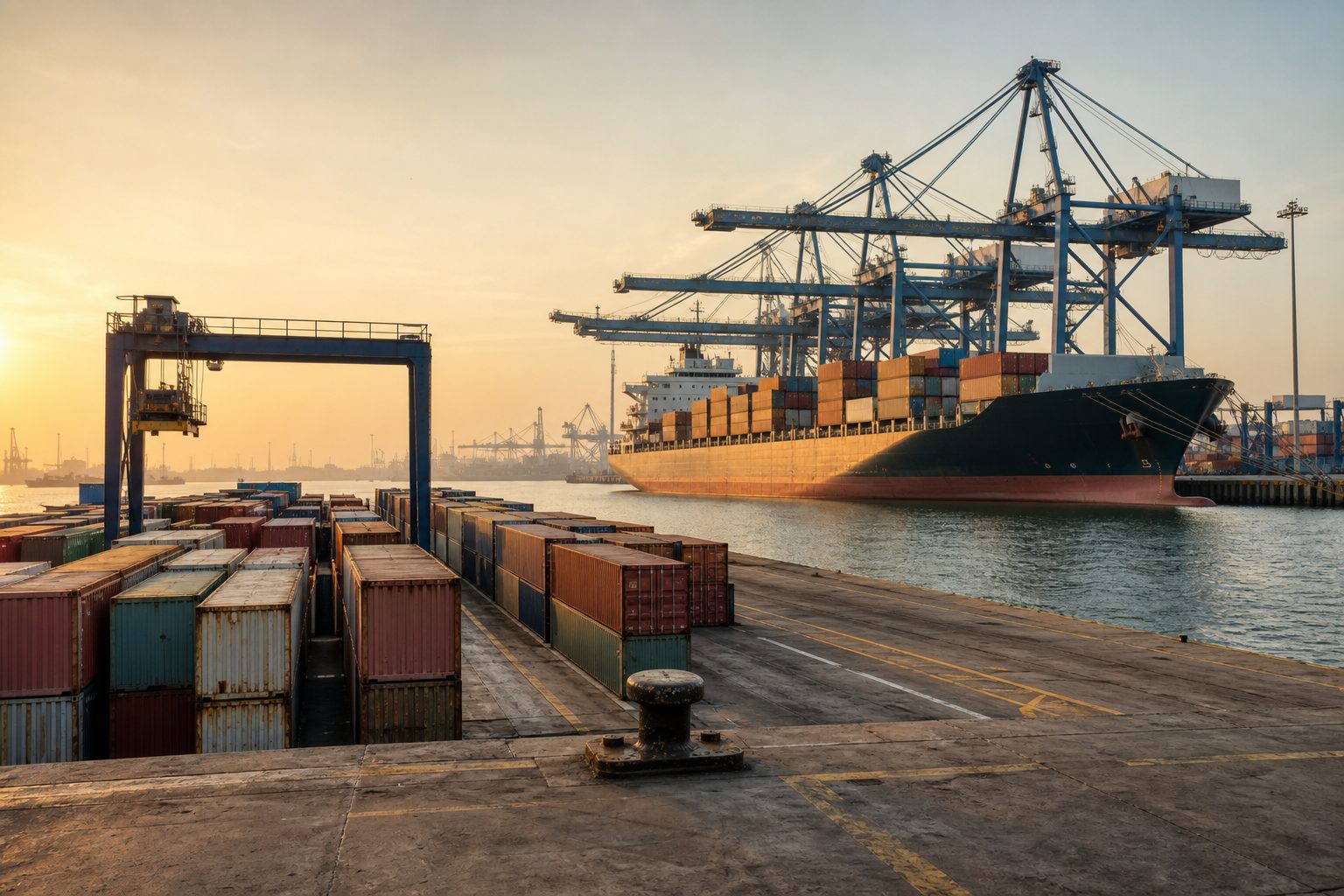
Importing from China to India means paying Basic Customs Duty on the assessable value of your goods, a Social Welfare Surcharge of 10% on that duty, and then IGST on all of it added together — and getting your Bill of Entry cleared through ICEGATE with an IEC code, the right ITC(HS) classification, and BIS certification wherever a Quality Control Order applies. There is no de minimis floor to hide behind: India’s duty-free allowance for commercial imports is effectively zero, so a 30-unit pilot order is assessed exactly like a container.
This guide is for businesses buying Chinese goods for the Indian market. It covers what you actually pay, the registrations and documents that get a shipment released, the compliance wall that stops more first-time importers than duty ever does, and how the three shipping modes compare on cost and transit time.
Why India is a different import market in 2026
China is India’s largest trading partner, and the dependency runs deepest in exactly the categories most importers deal in. A September 2026 study by the Koan Advisory Group and the Institute of Chinese Studies found that India relies on China for core electronics components across 71 product lines under HS Chapter 85 — up from 44 in 2018–19, an increase of more than 60%.
Two 2026 developments cut in opposite directions, and both matter to your landed cost:
| Development | Effective | What it means for you |
|---|---|---|
| Import duty removed on select electronics inputs | July 2026 | India scrapped the existing 7.5% and 5% levies on key parts for mobile phone wireless charging modules, displays for medical devices and automobiles, and lithium-ion cells. The exemption runs to 31 March 2029 |
| BIS certification extended across more product categories | Rolling, through 2026 | Quality Control Orders now cover hundreds of imported product lines. Non-compliant consignments are stopped at customs, not at the retail shelf |
The pattern is worth internalising: India is making it cheaper to import components and harder to import unverified finished goods. If your product falls under a QCO, compliance is not a formality you can defer to your Indian buyer.
What you actually pay: BCD, SWS and IGST
India stacks its import charges rather than levying a single duty. Four charges apply to essentially every commercial consignment:
| Charge | Calculated on | Typical rate | Notes |
|---|---|---|---|
| Basic Customs Duty (BCD) | Assessable value of the goods | 0%–70% depending on ITC(HS) code | Consumer electronics commonly sit in the 15–20% band; some categories are far higher |
| Social Welfare Surcharge (SWS) | The BCD payable | 10% | Introduced in Budget 2018 to replace the education cess — it is a surcharge on the duty, not on the goods |
| IGST | Value of goods + BCD + SWS | 5%–28%, standard 18% | Charged on the duty as well as the goods, which is why the effective rate exceeds the headline |
| Customs handling fee | CIF value | 1% | Levied on goods value plus freight and insurance |
Three further levies apply selectively and are worth checking before you commit to a price:
- Anti-dumping duty — imposed where goods are found to be sold below cost or market value in the exporting country. India investigates and applies these case by case, and Chinese-origin goods feature regularly.
- Countervailing duty (CVD) — offsets subsidies the exporting country grants its manufacturers.
- Safeguard duty — a temporary measure against a sudden import surge, applied by product rather than by country.
- GST Compensation Cess — sits on top of IGST for a defined list of goods, mostly luxury and specific consumer categories.
A worked example
Take a consignment of consumer electronics with an assessable value of ₹10,00,000 (ten lakh rupees), an assumed BCD rate of 20%, and IGST at 18%:
| Step | Calculation | Amount |
|---|---|---|
| Basic Customs Duty | ₹10,00,000 × 20% | ₹2,00,000 |
| Social Welfare Surcharge | ₹2,00,000 × 10% | ₹20,000 |
| Subtotal for IGST | ₹10,00,000 + ₹2,00,000 + ₹20,000 | ₹12,20,000 |
| IGST | ₹12,20,000 × 18% | ₹2,19,600 |
| Total duty and tax | ₹4,39,600 |
A 20% duty rate has become a 44% add-on. This is the single most common arithmetic error in Indian import planning: importers budget on the BCD rate and are surprised by the IGST, which is charged on the duty itself. Recall that IGST is creditable for a GST-registered business — but only if you are registered, and only against output tax, which is cold comfort on a pilot order you have not yet sold.
And there is no threshold to slip under. India’s de minimis value is INR 0. Express couriers, samples and small parcels are all dutiable, so a low-value shipment carries the same compliance obligations as a container, minus the economies of scale.
The registrations and documents that get your shipment released
Indian clearance is a document and registration game before it is a logistics one. Missing paperwork is the most common reason consignments sit at port accruing storage charges.
| Item | Issued or obtained by | Why it matters |
|---|---|---|
| Importer-Exporter Code (IEC) | DGFT | The prerequisite for importing commercially. Without it there is no Bill of Entry in your name |
| Bill of Entry (BoE) | Importer or customs broker, filed on ICEGATE | The legal declaration that starts clearance. Filed electronically and supported by document upload |
| eSANCHIT document set | Importer or broker | The electronic upload route for invoices, packing lists, bills of lading, certificates and licences attached to the BoE |
| Commercial invoice and packing list | Chinese supplier | Establishes declared value and matches quantities to the physical consignment |
| Bill of lading, air waybill or road waybill | Carrier | Proves the transport contract and the gateway of arrival |
| Certificate of Origin | Issuing authority in China | Establishes origin. India and China have no free trade agreement, so there is no preferential rate to claim — but origin still drives anti-dumping and safeguard exposure, and the certificate is now verified digitally |
| BIS registration / QCO certificate | Bureau of Indian Standards | Required where a Quality Control Order covers your product. Customs enforces it at the border |
| Test reports and conformity file | Manufacturer or accredited lab | Supports the BIS position and is what an audit asks for first |
| ITC(HS) classification | You, or your broker | Determines duty rate, licensing and whether your product is Free, Restricted or Prohibited under Schedule I |
One structural point about the ITC(HS) code: India’s Foreign Trade Policy now operates as a living document, updated by notification rather than on a fixed cycle, and DGFT moved to a granular 8-digit classification. The practical consequence is that the correct code for your product can change while your order is in production. Lock the code before you place the order, and re-check it before the goods ship.
BIS and QCO: the wall most first-time importers hit
Duty is predictable. Compliance is where shipments actually die.
A Quality Control Order (QCO) is not a customs rule — it is a product regulation issued by a ministry, enforced by customs at the port. If your product line is covered, the consignment needs BIS certification or a valid exemption. Arriving without either means the goods do not clear, regardless of how correctly you paid duty.
Two 2026 mechanisms are worth knowing, because they are what turn a blocked shipment into a recoverable one:
- The Transition Facilitation (Quality Control) Order, 2026. DPIIT introduced a 180-day transition window for goods dispatched or purchased before the relevant QCO came into force. Eligibility turns on the Bill of Lading and Bill of Entry dates falling within 180 days of the order taking effect. Guidance on how to operate the exemption was published in June 2026.
- Facilitated BIS registration (Scheme II). Introduced in July 2026 for selected QCO products, it allows eligible Indian companies to register rather than undergo full factory inspection under Scheme I — a materially shorter route to market.
The workstream is unglamorous but decisive: identify every QCO that touches your product before the order is placed, start the certification clock while the factory is still producing, and keep the Bills of Lading. Importers who treat BIS as a post-arrival problem pay for it in demurrage.
Routes into India: sea, air and express
| Mode | Main gateways | Typical transit | Best for |
|---|---|---|---|
| Sea freight — FCL | Nhava Sheva (JNPT), Mundra, Chennai, Kolkata, Cochin | 14–22 days port to port from South China, Shanghai to Nhava Sheva often 12–20 days | Volume, heavy goods, full-container electronics |
| Sea freight — LCL | Same ports, plus inland container depots at Tughlakabad (Delhi) and Bengaluru | Add roughly a week for consolidation and deconsolidation | Mixed cartons below container volume |
| Air freight | Delhi, Mumbai, Chennai, Bengaluru, Hyderabad | 2–8 days | High-value, launch stock, urgent replenishment |
| Express courier | Door to door | 2–5 days | Samples and small parcels — remember duty applies from rupee one |
Indicative 2026 rates run around USD 800–1,500 for a 20-foot FCL container and USD 18–35 per CBM for LCL. Those are freight-line numbers, not landed cost; add duty, IGST, port charges, inland transport and brokerage before you compare a Chinese vendor against a domestic distributor.
The gateway that makes sense depends on where your buyers are. Western India (Mumbai, Pune, Gujarat) usually clears through Nhava Sheva or Mundra. Southern buyers are cheaper through Chennai or Cochin. Northern importers often do better routing through Mundra and moving inland by rail to an ICD than paying for direct port handling.
What to do before you place the order
- Get your IEC first. Everything downstream depends on it.
- Classify the product properly. A wrong ITC(HS) code distorts your duty, your licensing position and your compliance obligations at the same time.
- Check QCO coverage in writing. Ask the question of a compliance consultant, not of the supplier. Factories routinely do not know which Indian QCOs cover what they make.
- Price the duty stack, not the duty rate. Model BCD, SWS, IGST and the handling fee together, as in the worked example above.
- Verify the supplier before payment. A Chinese factory that cannot produce the test reports your QCO demands is a factory that cannot supply you, however good the sample looks.
- Inspect before the goods leave China. Discovering a defect after Indian clearance means you have paid duty and IGST on defective stock, and funded the return yourself.
Steps 5 and 6 are the ones importers most often skip, and they are the two an agent earns its fee on. Our sourcing and purchasing team vets suppliers for export documentation habits and compliance capability rather than price alone, and a pre-shipment inspection verifies the goods while fixing them is still the factory’s problem.
How to keep your landed cost down
- Consolidate multiple suppliers into one consignment. One Bill of Entry means one set of clearance, inspection and documentation costs instead of five. Our warehouse and consolidation service is built exactly for this.
- Claim the 2026 electronics exemptions where they apply. The parts duties removed in July 2026 run to 31 March 2029 — if your supply chain touches lithium-ion cells or the specified display and charging components, confirm your broker is classifying them under the exempt lines.
- Use the QCO transition window if you have been caught mid-order. The 180-day exemption is date-driven, so keep Bills of Lading and Bills of Entry properly filed.
- Match the mode to the deadline. Sea for volume, air only when the margin justifies it, express never for commercial quantities.
- Reduce the number of suppliers you buy from. Every additional factory is another set of documents, another payment, another collection and another compliance question.
- Inspect in China, not in India. Duty and IGST are charged on what you import. Finding defects before the container ships is the only version of quality control that saves you money rather than documenting your loss.
If you sell under your own brand, OEM and ODM customisation handles private-label packaging and market-specific labelling at the factory stage — cheaper to fix there than in a warehouse. For the sourcing side of the same question, our guide to what a China sourcing agent does walks through the process end to end, and the Vietnam import guide is useful if you distribute across multiple Asian markets.
FAQ: importing from China to India
How much is import duty from China to India? There is no single rate. Duty is set per ITC(HS) code and can range from 0% to 70%. On top of Basic Customs Duty you pay a Social Welfare Surcharge of 10% on the duty amount, then IGST (standard 18%) on the goods value plus BCD plus SWS, plus a 1% customs handling fee on CIF value. A 20% BCD rate typically works out to roughly a 44% addition once the full stack is applied.
Is there a duty-free limit for imports into India? Effectively no. India’s de minimis value is zero, so every commercial consignment is dutiable regardless of value. Express parcels and small orders are assessed on the same structure as a container.
Do I need an IEC to import from China? Yes. The Importer-Exporter Code issued by DGFT is the prerequisite for commercial importing. Your Bill of Entry is filed in the name of the IEC holder, either directly or through a customs broker.
What is a Bill of Entry and where is it filed? The Bill of Entry is the legal customs declaration that initiates clearance. It is filed electronically through ICEGATE, with supporting documents uploaded through eSANCHIT. Duty is also paid through the ICEGATE e-payment facility.
Does India have a free trade agreement with China? No. There is no preferential tariff arrangement between India and China, so Chinese-origin goods are assessed at the applicable MFN rate. What origin documentation does affect is exposure to anti-dumping and safeguard duties, which are applied case by case.
What is BIS certification and do I need it? BIS certification is required for product lines covered by a Quality Control Order issued by the Indian government. QCOs are product regulations enforced by customs at the border, so goods arriving without certification or a valid exemption do not clear. Coverage has expanded substantially through 2026, so confirm the position for your specific product before ordering.
How long does customs clearance take in India? Well-documented consignments filed accurately can clear quickly; consignments flagged for document review or physical examination take longer. The dominant variable is the completeness of your filing, not the port. Most avoidable delays trace back to an incorrect ITC(HS) code, a missing QCO document or a value the officer cannot reconcile.
How long does shipping from China to India take? Sea freight typically runs 14–22 days port to port depending on the route, with Shanghai to Nhava Sheva often in the 12–20 day range. Air freight takes 2–8 days and express couriers 2–5 days. Add clearance and inland transport before quoting a delivery date to a customer.
Can I import small quantities from China to India? Yes, and low minimum order quantities are one of the reasons buyers use a sourcing agent. The constraint is not volume but compliance: a 50-unit pilot still needs an IEC, a correct classification, and BIS coverage where a QCO applies.
Should I buy directly from a Chinese supplier or use an agent? Direct works if you already have a trusted factory, a customs broker who knows your category, and a tested inspection process. An agent earns its fee when you are buying from several suppliers, need pre-shipment inspection, want goods consolidated into one Bill of Entry, or need someone to confirm the compliance position before the money moves rather than after the container arrives.
Importing into India in 2026: the short version
Get the IEC. Classify the product correctly and re-check the code before shipping. Model BCD, SWS, IGST and the handling fee together instead of budgeting on the headline rate. Confirm QCO and BIS coverage before you place the order, and keep your Bills of Lading in case you need the 180-day transition window. Then choose the gateway that matches where your buyers actually are.
If you would rather not manage four Chinese suppliers, a QCO question and a port decision at the same time, tell us what you are importing — we will map the sourcing, inspection, documentation and shipping path for India before you commit to an order. Easy Buy China works with retailers, wholesalers and online sellers in more than 50 countries, with no consultation fee and low MOQ flexibility.