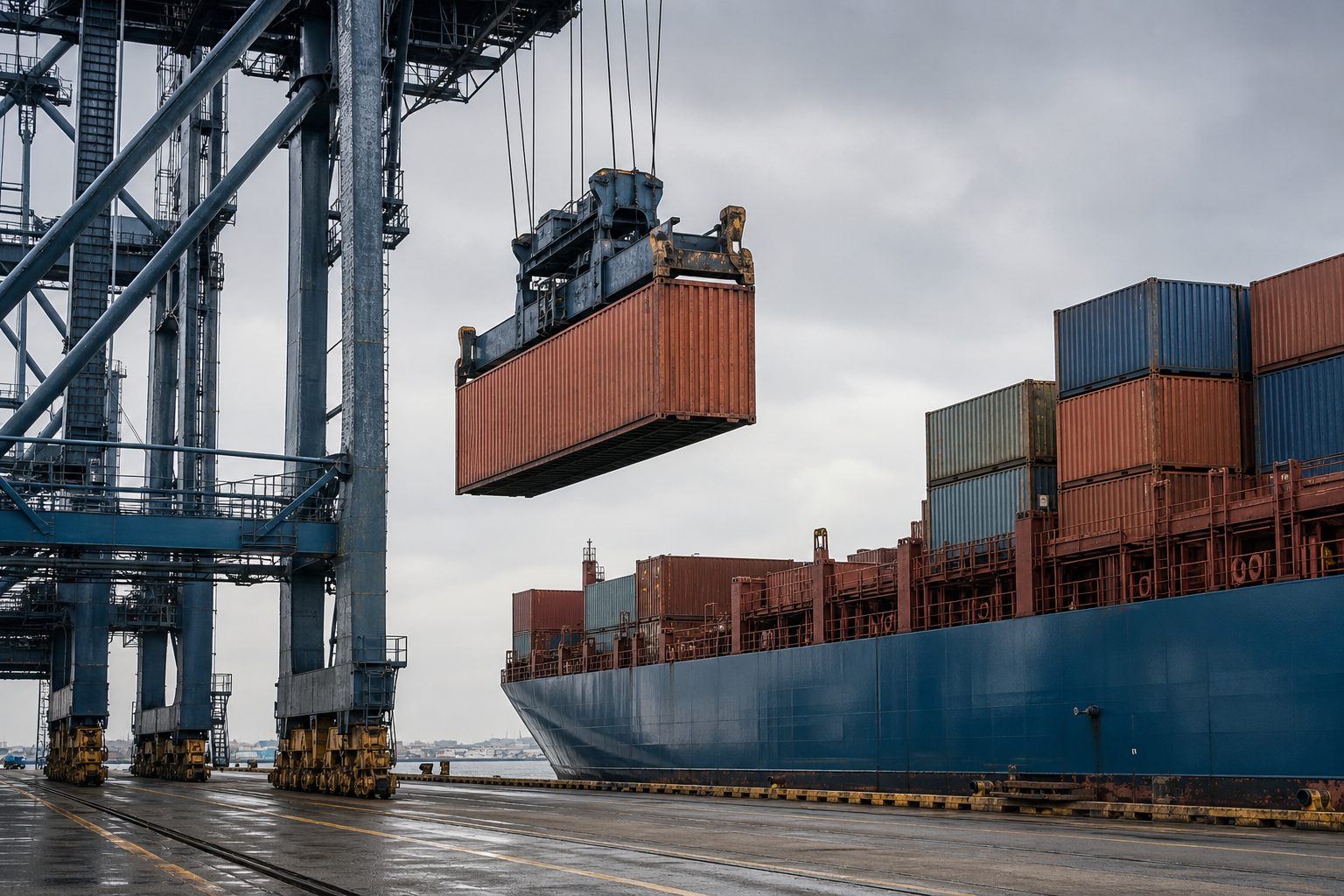
Incoterms are the three-letter rules that decide where your responsibility for a shipment starts and ends — who arranges carriage, who pays which cost, and at exactly which point the risk of loss passes from seller to buyer. The current edition is Incoterms 2020, published by the International Chamber of Commerce, and it contains eleven rules split into two groups: seven that work with any transport mode, and four reserved for sea and inland waterway shipments. Get the term wrong and you can be holding the loss for goods you thought the supplier was still responsible for.
This guide explains what Incoterms do and do not cover, walks through all eleven rules, and shows which of them you will actually be quoted when sourcing from China.
What Incoterms decide — and what they don’t
Three things are settled by the Incoterm alone:
- Cost — which party pays freight, insurance, terminal handling, export and import clearance, and duties.
- Risk — the precise point at which loss or damage becomes your problem rather than the seller’s.
- Obligations — who contracts the carrier, who handles export and import formalities, and who provides which documents.
Four things that people wrongly assume are covered:
| Not covered by Incoterms | Set by |
|---|---|
| The price of the goods | Your contract or purchase order |
| When and how you pay | Payment terms (T/T, letter of credit, escrow) |
| Who owns the goods at any moment (title) | Your contract’s terms of sale, and the applicable law |
| Whether the goods match the specification | Product spec, samples and inspection |
That last row is the one that costs importers real money. A DDP term does not mean the seller is responsible for quality. It means they are responsible for delivering to your door with duty paid. If the goods are wrong, the Incoterm will not help you — your inspection and payment terms will.
The two groups
Incoterms 2020 divides its eleven rules by transport mode, and the split is not cosmetic. Using a sea-only rule for air freight is a genuine error, not a technicality.
| Group | Rules | Use for |
|---|---|---|
| Any mode of transport | EXW, FCA, CPT, CIP, DAP, DPU, DDP | Sea, air, road, rail, courier, or multimodal shipments |
| Sea and inland waterway only | FAS, FOB, CFR, CIF | Bulk and non-containerised cargo loaded directly onto a vessel |
The reason the four sea rules are restricted: they transfer risk at the ship’s side or on board the vessel, a moment that only exists when cargo is lifted over the rail. Containerised cargo handed to a terminal days before loading never experiences that moment, which is precisely why FCA, not FOB, is the correct rule for container shipments.
All eleven rules compared
| Rule | Who arranges main carriage | Who pays main freight | Risk passes to buyer | Insurance obligation | Notes |
|---|---|---|---|---|---|
| EXW — Ex Works | Buyer | Buyer | On collection at the seller’s premises | None | Buyer is exporter of record. Practically unusable for imports from China |
| FCA — Free Carrier | Buyer | Buyer | On delivery to the carrier the buyer nominated | None | The correct rule for containerised goods |
| FAS — Free Alongside Ship | Buyer | Buyer | When goods are placed alongside the vessel | None | Sea only; bulk cargo |
| FOB — Free On Board | Buyer | Buyer | When goods are on board the vessel | None | Sea only; the classic misused term |
| CFR — Cost and Freight | Seller | Seller | When goods are on board the vessel | None | Risk passes before the seller’s costs stop |
| CIF — Cost, Insurance and Freight | Seller | Seller | When goods are on board the vessel | Seller, minimum cover | Sea only; insurance is Institute Cargo Clauses (C) |
| CPT — Carriage Paid To | Seller | Seller | On delivery to the first carrier | None | Any-mode equivalent of CFR |
| CIP — Carriage and Insurance Paid To | Seller | Seller | On delivery to the first carrier | Seller, broad cover | Any-mode equivalent of CIF, with Institute Cargo Clauses (A) |
| DAP — Delivered At Place | Seller | Seller | On arrival at the named destination, ready for unloading | None | Buyer clears import and pays duty |
| DPU — Delivered at Place Unloaded | Seller | Seller | After unloading at destination | None | The only rule where the seller must unload |
| DDP — Delivered Duty Paid | Seller | Seller | On arrival, ready for unloading, duty paid | None | Maximum seller obligation; seller needs an importer position at destination |
The pattern to notice sits in the middle four rules. Under CFR, CIF, CPT and CIP the seller pays freight all the way to the destination, but risk passes much earlier — at the vessel or the first carrier. That gap is where disputes live: if the container is lost mid-voyage under CIF, the seller has paid for a shipment that no longer exists, and the buyer carries the loss. This is why insurance matters most under exactly the rules where people assume they are most protected.
The five rules you will actually be quoted from China
Most Chinese suppliers quote one of five terms. Here is what each one really transfers.
EXW — Ex Works
The seller makes the goods available at their factory. You arrange everything: inland haulage in China, export declaration, freight, import clearance, duties, final delivery. This is the worst possible term for an overseas buyer. You become the exporter of record in China, which requires a Chinese export licence you almost certainly do not hold. Chinese suppliers quote EXW because it is the simplest term for them, not because it is good for you. Push back.
FCA — Free Carrier
The seller clears the goods for export and delivers them to a carrier you nominated at a named place — typically a Chinese inland depot or container yard. Risk transfers there. For containerised shipments, this is the rule you want. It keeps export clearance with the party who can actually perform it, while leaving freight and insurance to you so you can use your own forwarder and your own rates.
Incoterms 2020 added a useful mechanism here: the buyer can instruct the carrier to issue a bill of lading with an on-board notation to the seller, which solves a long-standing problem for buyers paying by letter of credit who needed an on-board bill of lading before the container was actually loaded.
FOB — Free On Board
The seller delivers the goods on board the vessel at the named port of shipment. Risk passes when the goods are on board. Freight and insurance are yours.
FOB is the most widely quoted term in Chinese sourcing and the most widely misused. It was designed for cargo lifted directly over the ship’s rail. For a container that sits at a terminal for a week before loading, there is no clean “on board” moment at handover, and neither party controls the goods during the gap. In practice FOB is usually acceptable if you are shipping FCL and your forwarder is competent — but FCA is the technically correct rule, and it removes an argument you do not need to have.
CIF — Cost, Insurance and Freight
The seller pays freight and insurance to the named destination port. Risk still passes on board the vessel in China. Insurance is minimum cover — Institute Cargo Clauses (C), which excludes a long list of perils including theft in many circumstances.
Two things to check before accepting CIF: the insurance cover level, and whether the seller is overstating freight. CIF lets the seller bundle freight into the product price, which makes it very hard to compare suppliers. Ask for the FOB or FCA price alongside it so you can see what the freight actually costs.
DDP — Delivered Duty Paid
The seller delivers to your named destination with import duty and taxes paid. Maximum convenience, maximum opacity. You cannot see what you paid for freight or duty, and in most markets a foreign seller cannot legally act as importer of record without a local entity. If DDP is offered and the seller cannot explain who clears the goods and in whose name, treat it as a warning sign rather than a convenience.
The two mistakes that cost the most
1. Using FOB for containerised cargo. It is not wrong in everyday practice, but FCA is the correct rule, and the difference matters when something goes missing between the terminal gate and the vessel. Align the term with the physical reality of how your cargo moves.
2. Assuming DDP transfers responsibility for quality. It does not. DDP is a delivery term. It says nothing about whether the goods match the specification, and it will not support a claim for defective stock. If you want protection on quality, buy it through inspection and payment terms.
A third, quieter error is worth mentioning: quoting a term without a named place. “FOB China” is not a term, it is an argument waiting to happen. Every Incoterm must be followed by a specific place — “FOB Shenzhen, Yantian,” “FCA Ningbo,” “DDP Mumbai.” The whole point of the rule is the precision of the handover point.

Which term should you choose?
| Situation | Recommended | Why |
|---|---|---|
| Containerised goods, you control freight and insurance | FCA | Correct risk transfer, export clearance stays with the seller |
| Containerised goods, you want the familiar term | FOB | Acceptable in practice for FCL; specify the port |
| Bulk or non-containerised cargo | FOB or FAS | Designed for cargo lifted directly onto the vessel |
| You want the seller to arrange freight but not duty | CPT or CIP | Risk passes at the first carrier; check the insurance cover |
| You want delivery to your door, duty paid by the seller | DDP | Only if the seller can lawfully act as importer of record |
| You want delivery to your door, you clear import | DAP | Clean split: seller delivers, you handle import formalities |
| The supplier quotes EXW | Re-quote as FCA | EXW makes you the exporter of record in China |
If you are buying from several Chinese suppliers and consolidating, the term interacts with the consolidation rather than replacing it. Goods bought FCA and consolidated into one shipment mean one set of export documents and one freight booking instead of five — see how our warehouse and consolidation service handles that, and how the sourcing and purchasing team negotiates the term as part of the order rather than as an afterthought.
FAQ: Incoterms for importers
Which version of Incoterms is current? Incoterms 2020, published by the International Chamber of Commerce, is the current edition. Always state the version in your contract — “FOB Yantian, Incoterms 2020” — because the rules changed between editions.
What is the difference between FOB and FCA? FCA transfers risk when the goods are handed to the carrier you nominated; FOB transfers risk when the goods are on board the vessel. FOB is a sea-only rule designed for cargo loaded directly over the ship’s rail. For containerised cargo, FCA is the correct rule.
Who pays import duty under CIF? You do. CIF covers cost, insurance and freight to the destination port. Import clearance, duty, taxes and inland delivery remain the buyer’s responsibility. If you want duty included, the term is DDP.
Does DDP mean the seller is responsible for quality? No. Incoterms govern cost, risk and delivery obligations only. Quality is settled by your product specification, samples, inspection terms and payment conditions — not by the trade term.
Is FOB or CIF better for buying from China? It depends on who can get better freight rates and how much visibility you want. FOB leaves freight and insurance with you, which usually gives you lower rates and a clear cost breakdown. CIF bundles freight into the supplier’s price, which is simpler but harder to audit. Ask for both prices and compare the freight line specifically.
What insurance cover does CIF require? Minimum cover: Institute Cargo Clauses (C). It is deliberately narrow and excludes many perils. Under CIP, Incoterms 2020 requires broader cover — Institute Cargo Clauses (A). If you are shipping under CIF, buy your own cover or agree a higher level in the contract.
Can I use FOB for air freight? No. FOB is restricted to sea and inland waterway transport. For air freight use FCA, CPT or CIP.
Why do Chinese suppliers keep quoting EXW? Because it is the lowest-effort term for them: the goods leave the factory and their responsibility ends. It shifts export clearance to you, which is a problem because it normally requires a Chinese export position. Ask for an FCA price instead.
Do Incoterms cover payment terms? No. Payment is governed by your contract, not by the trade term — typically T/T, a letter of credit or an escrow arrangement. The Incoterm and the payment method are separate negotiations, and a buyer financing a first order usually wants the payment schedule tied to inspection milestones rather than to the delivery term.
What happens if the Incoterm is not specified in the contract? You will be arguing about it after a loss, which is the expensive way to learn the rule. Put the three-letter term, the named place and the version year in writing on every purchase order.
The short version
Incoterms decide cost, risk and delivery obligations — nothing else. Use FCA or FOB when you are controlling freight, CPT or CIP when the seller arranges carriage, DAP when you clear import and DDP only when the seller can lawfully act as importer of record. Never quote a term without a named place, never use a sea rule for air freight, and never assume a delivery term is a quality guarantee.
The term is part of the negotiation, not a box to tick after the price is agreed. When we source a product for you, the trade term, the inspection scope and the consolidation plan are agreed together — because a good unit price under the wrong Incoterm is not a good deal. Easy Buy China works with importers in more than 50 countries with no consultation fee and low MOQ flexibility; see how the process works end to end.