作者: Chloe Feng

  • What Is a China Sourcing Agent? How It Works, What It Costs, and How to Choose One

    What Is a China Sourcing Agent? How It Works, What It Costs, and How to Choose One

    A China sourcing agent is a company that buys products from Chinese suppliers on your behalf and manages the whole order for you — supplier vetting, negotiation, payment, quality control, consolidation and shipping to your door. You brief the agent on the product, target price, quantity and destination; the agent turns that brief into a vetted supplier, a quotation, an inspected shipment and a tracking number. You deal with one contact instead of a dozen factories, trading companies and freight brokers.

    That definition is the short version. The rest of this guide covers what the role actually includes, when you genuinely need one, how the process runs step by step, the fee models you will be quoted, and the checks that separate a reliable agent from an expensive middleman.


    What a China sourcing agent actually does

    A sourcing agent’s job is to absorb the parts of importing that are hardest to do from another country. In practice that means five things:

    • Supplier identification and vetting — finding factories and authorized distribution channels, then checking that they are real, licensed and able to supply the product you specified.
    • Negotiation on your behalf — agreeing unit price, minimum order quantity, packaging, lead time and payment terms in the supplier’s language.
    • Quality control before shipping — inspecting the goods in China while problems are still fixable, and sending you photo or video evidence rather than assurances.
    • Consolidation and warehousing — receiving goods from multiple suppliers, re-checking them, and packing them into one outbound shipment.
    • Export documentation and delivery — handling the paperwork, customs coordination and the final leg to your warehouse, store or fulfillment center.

    A sourcing agent is not the same as a marketplace or a freight forwarder

    This is where most first-time buyers get confused, because the four roles overlap at the edges but solve different problems.

    You are dealing withWhat they doWhat they do not do
    Sourcing agentFinds and vets suppliers, negotiates, places orders, inspects, consolidates, shipsManufacture the product; own your brand
    Marketplace (Alibaba, 1688, etc.)Lists suppliers and provides contact and escrow toolsVet quality for your order, inspect goods, consolidate multiple suppliers
    Trading companyBuys from a factory and resells to you at a markupDisclose its source factory, work on your margin terms
    Freight forwarderMoves goods you have already boughtFind suppliers, negotiate price, run quality control

    A useful way to think about it: a marketplace gives you options, a forwarder gives you movement, and an agent gives you outcomes. If your problem is “I cannot tell which of these 40 suppliers is real, and I do not want to pay for goods I have never seen,” you need an agent. If your problem is only “my container needs to move from Ningbo to Rotterdam,” you need a forwarder.


    When you need a sourcing agent — and when you do not

    Sourcing agents are not automatically worth their fee. The honest test is whether the work they do is work you can do yourself, cheaper and better.

    You will usually benefit from an agent when:

    • You are buying from several suppliers and want one consolidated shipment instead of five freight quotes and five sets of paperwork.
    • You cannot verify that a supplier is real, licensed, and actually able to produce what they advertise.
    • You need inspection before the goods ship, not a dispute process after they arrive.
    • You are importing branded or regulated goods, where authenticity, regional versions and destination compliance carry real risk.
    • Your order size is below the level at which factories will take you seriously on their own.
    • You are testing a new category and want a pilot order rather than a container commitment.

    You probably do not need one when:

    • You buy a single SKU in high volume from a factory you already know and trust.
    • You already run your own quality inspection and freight program.
    • You only need transport — that is a forwarder’s job.
    • You want a supplier list and intend to manage every step yourself.

    There is no shame in the second list. Paying a fee for work you are already doing is not diligence, it is overhead.


    How the process works, step by step

    A well-run sourcing engagement follows a predictable sequence. Problems in first orders almost always trace back to a step being skipped rather than to the wrong product being chosen.

    Step 1 — Brief and consultation

    You describe the product, target price, quantity, quality level and destination country. This is the highest-leverage hour of the whole project: the clearer your brief, the fewer sampling rounds and surprises later. A good agent will push back on unrealistic target prices here rather than quietly accepting them and disappointing you in production.

    Step 2 — Supplier matching and quotation

    The agent identifies which factories or distribution channels can actually supply your specification, and flags anything that cannot be supplied reliably. You should receive a consolidated quotation that includes the product cost and the costs around it — inspection, consolidation, freight and duties — rather than a bare unit price.

    Step 3 — Sampling and order placement

    Before a production run, order samples and test them yourself. This is also where customisation decisions get locked in: materials, packaging, branding, manuals and plug types. Only after samples are approved does the bulk order go to the factory, with quality standards and inspection points agreed in writing.

    Step 4 — Quality control before shipping

    The critical step. Goods are inspected in China while there is still time to fix or reject them. Ask for evidence you can actually evaluate — video or photo inspection of the real units and cartons, not stock images supplied by the factory. If a supplier resists inspection, that is itself information.

    Step 5 — Warehousing and consolidation

    If your order comes from multiple suppliers, everything is received, re-checked and packed into a single outbound shipment. Consolidation is where freight cost stops being proportional to the number of suppliers you bought from.

    Step 6 — Export, customs and final delivery

    The agent coordinates export documentation and customs clearance and delivers to your address, warehouse or fulfillment center, with tracking you can follow.

    Easy Buy China runs this sequence as one managed service: supplier matching within 24 hours of your brief, verified procurement, pre-shipment video inspection, free warehousing while an order is consolidated, and door-to-door delivery. You can see the full flow on the how it works page.


    What it costs: the fee models you will be quoted

    There is no single industry rate, because agents charge for different scopes of work. Almost every quotation you receive will be one of four models, or a combination.

    Fee modelHow it worksWhere you will see itWhat to watch
    Percentage of order valueAgent takes a commission on the value of goods purchasedMost common model for general sourcingDoes the percentage apply to product cost only, or also to freight and inspection?
    Flat fee per orderFixed amount per purchase order or per shipmentSmaller orders, simple single-supplier buysCheaper on large orders, can be expensive on repeated small ones
    Retainer or monthly feeFixed monthly amount covering ongoing sourcing activityBuyers with continuous, multi-category purchasingAsk what happens in a month with no orders
    HybridMinimum fee plus percentage above a thresholdMid-size importersMake sure the minimum is stated in writing

    What actually drives your fee up or down

    • Order value — small orders carry proportionally higher handling cost, so minimum fees appear.
    • Number of suppliers — five suppliers means five negotiations, five payments and five collections.
    • Number of SKUs and customisation — OEM or private label work adds development and sampling cycles.
    • Inspection depth — a visual carton check is not the same work as one-by-one unit verification.
    • Freight mode and destination — air versus sea, and how demanding the destination market’s compliance rules are.

    The number that matters is landed cost, not unit price

    A low factory price tells you almost nothing until you add everything around it:

    Landed cost = product cost + agent fee + inspection + consolidation + freight + duties and taxes + payment costs

    Two quotations can differ by 40% at the unit-price line and land within 5% of each other once freight, consolidation and duties are added. Always ask for a landed-cost breakdown before comparing suppliers — our shipping from China guide walks through the freight and customs side of that calculation.

    One structural note worth understanding: some agents build their margin into the wholesale price they quote instead of billing a separate consultation fee. Easy Buy China works this way — consultation carries no fee, and pricing is quoted as a complete package. Whatever model you choose, get the fee structure in writing before the first order, and treat any quote that cannot be explained line by line as a warning sign.


    How to choose a sourcing agent: 7 checks

    Run these before you send money, not after.

    1. Can they name where the goods will come from? A credible agent can tell you which factories or authorized channels will supply your order, and will tell you plainly when something cannot be sourced. Vague answers here predict vague outcomes.
    2. Do they show inspection evidence as standard? Ask what an inspection report looks like before you order. If the answer is “we check the goods,” rather than a sample video or photo report, keep looking.
    3. Is the pricing transparent and complete? You want product cost, agent fee, inspection, consolidation, freight and duties in one document. Hidden markups usually appear later as “unexpected” charges.
    4. Do they handle regional versions and compliance? Plug types, voltage, app language, manual language and packaging language differ by market — and are the single most common source of unsellable stock. For branded goods, authenticity documentation matters just as much; our guide to brand sourcing covers that process in detail.
    5. Can they consolidate several suppliers? If you buy five brands from five suppliers, consolidation is where your cost advantage is protected or lost.
    6. Who owns after-sales and warranty claims? Establish in writing who replaces defective units and how, before you need it.
    7. How fast and how clearly do they communicate? Responsiveness during the sales process is the best available predictor of responsiveness after your money has moved.

    Common mistakes first-time importers make

    • Skipping samples to save time. The cost of one bad production run usually exceeds the cost of the first two seasons.
    • Comparing unit prices instead of landed costs. See above — this is the single most expensive arithmetic error in importing.
    • Ordering too much at once. A pilot order of a modest quantity tells you what actually sells in your market at a fraction of the risk.
    • Assuming a familiar brand name means safety. Recognised products attract counterfeits; verification is not optional simply because you recognise the logo.
    • Treating quality control as optional. Inspection costs a small fraction of what unsellable inventory costs.
    • Ignoring lead times. Production plus shipping typically runs weeks, not days, so plan reorders before you run out, not after.

    If you are buying your first order from China, our guide for small retailers covers the low-MOQ and risk-management side in more depth, and the quality inspection guide explains what a pre-shipment inspection should include.


    FAQ

    What is the difference between a China sourcing agent and a trading company? A trading company buys from a factory and resells to you at a markup, keeping its source confidential. A sourcing agent works for you: it discloses the supply channel, negotiates on your terms, and charges a stated fee for the service rather than earning an undisclosed spread.

    How much do sourcing agents charge? It depends on the engagement model rather than a single industry rate. Agents typically quote a percentage of order value, a flat fee per order, a monthly retainer, or a hybrid with a minimum fee. The number moves with order value, how many suppliers are involved, how much customisation is required and how deep the inspection goes. Ask for the fee structure in writing and compare quotations on landed cost, not on unit price.

    Do I need a company in China to work with a sourcing agent? No. You buy as a foreign buyer and the agent handles the Chinese side — supplier negotiation, domestic collection and export documentation. What you do need is a clear brief and a destination address.

    Can a sourcing agent help with small orders? That is precisely where a good agent changes the equation. Factories enforce minimum order quantities because dealing with small buyers is not worth their time; an agent that consolidates demand from multiple buyers, or sources from distribution channels rather than production lines, can support genuine pilot orders. If low-volume testing matters to you, make it the first question you ask.

    Is it cheaper to just buy directly on Alibaba? Sometimes — if you already know the supplier, the product and the freight route. On a first order, the marketplace solves discovery and nothing else: it does not verify that the supplier can produce your specification, does not inspect your goods, and does not consolidate across suppliers. Buyers frequently discover that the savings on the commission are smaller than the cost of one rejected shipment.

    Who handles customs clearance? In a managed sourcing arrangement the agent coordinates export clearance from China and the documentation your goods need to travel. Import duties and destination-market taxes are normally your responsibility as the importer of record, and a good agent will tell you what those are likely to be before you order rather than after.

    How long does a first order take? Sampling and supplier selection usually dominate the early timeline, and production plus shipping sits on top of that. Buyers who need goods for a specific season should start the conversation well ahead of it rather than optimising for the fastest possible shipment.

    What does a sourcing agent need from me to start? Four things: the product and its specification, a target price, a quantity, and a destination country. Add your quality expectations and any branding requirements. That is enough for a serious agent to come back with a sourcing plan and a quotation.


    Send one brief, get a managed sourcing plan

    The value of a sourcing agent is not that they can find suppliers — search engines can do that. It is that they own the parts you cannot control from abroad: whether the supplier is real, whether the goods match the specification, and whether your shipment leaves China correctly documented and economically consolidated.

    Easy Buy China works as a single point of contact across that process, serving retailers, wholesalers and online sellers in more than 50 countries with $0 consultation fee and low MOQ flexibility. Send your product, target price, quantity and destination, and you will get a sourcing plan with a consolidated quotation — including a warehousing and delivery route and, where relevant, OEM or ODM customisation options.

    If you sell to consumers rather than businesses, the retailer sourcing page is the faster starting point.

  • Import from China to Vietnam: Duties, Customs and Shipping (2026 Guide)

    Import from China to Vietnam: Duties, Customs and Shipping (2026 Guide)

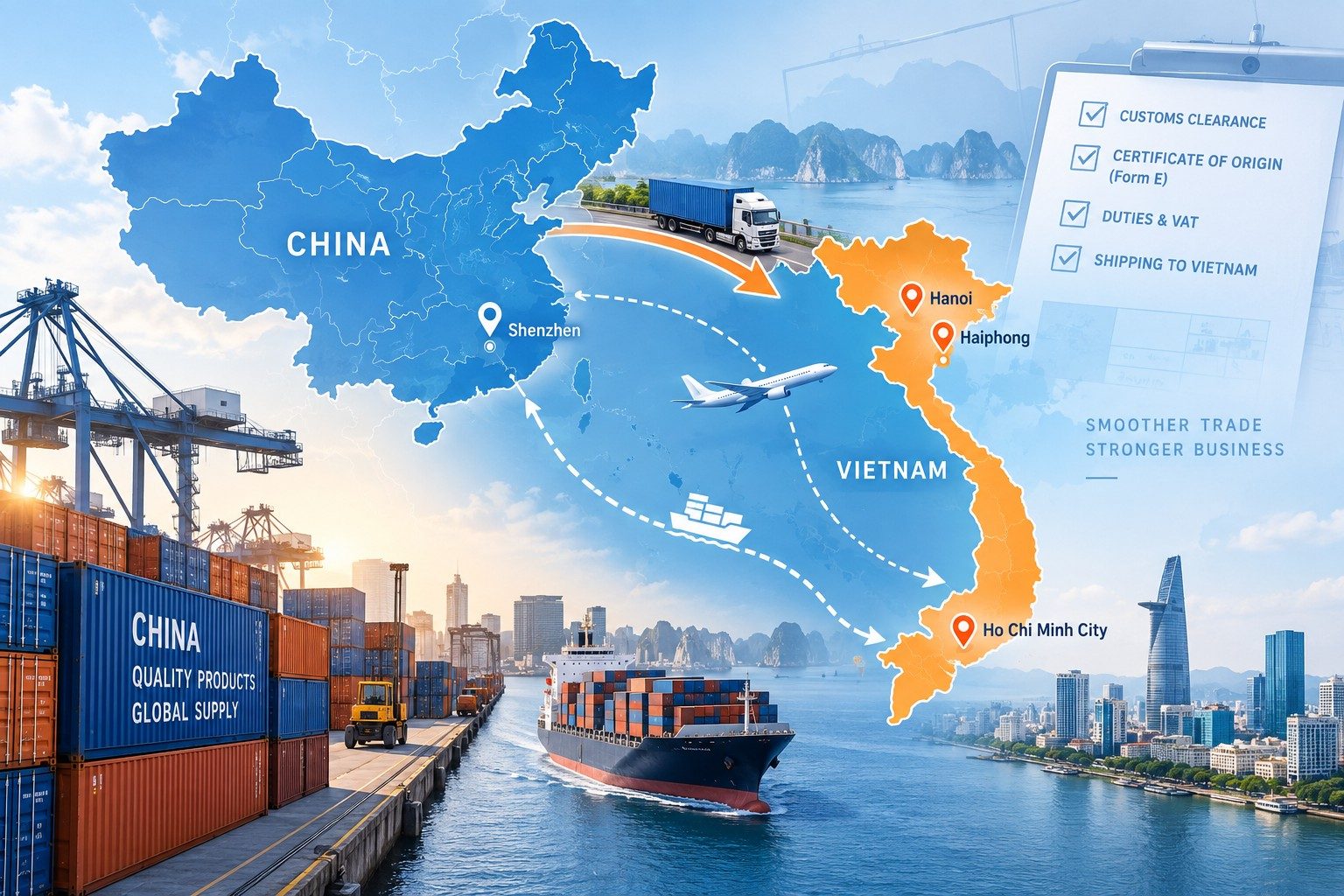
    Importing from China to Vietnam means paying import duty on the CIF value of your goods, then VAT on the CIF value plus duty — and in 2026 it also means clearing a completely rewritten rulebook. Vietnam put more than 200 laws, decrees and circulars into force on 1 July 2026, added another foreign-trade decree on 5 September 2026, and abolished the low-value exemption that used to cover small shipments. This guide is written for businesses buying Chinese goods for the Vietnamese market: what you pay in duty and VAT, which documents get a shipment released, which border gates move fastest, and how to keep your landed cost down.

    What importing from China to Vietnam involves

    Buying straight from a Chinese supplier is simple right up to the point where something goes wrong: a factory that cannot produce a valid Certificate of Origin, packaging that does not meet Vietnamese labelling rules, or a consignment sitting at the border while storage charges accumulate. Those are the six steps where Vietnamese importers most often lose time or money.

    StepWhat it involves
    1. Sourcing the supplierFactories identified and checked for pricing, capability and export documentation habits
    2. Negotiating the orderTarget price, MOQ and payment terms agreed with the factory
    3. Quality control before shippingInspection at the factory, before you pay duty and VAT on defective goods
    4. ConsolidationGoods from several suppliers collected and shipped as one consignment
    5. Export documentationOrigin certificates and export papers prepared so the shipment is not held at the border
    6. Freight and deliverySea, road or air arranged to Hanoi, Ho Chi Minh City or your own warehouse

    Why 2026 is a different year for Vietnam imports

    Vietnam did not tweak its import rules in 2026 — it replaced them. On 1 July 2026 alone, roughly 29 laws, 49 decrees and 72 circulars took effect, according to logistics law roundups published by Vietnamese freight and legal teams. Four of those changes affect almost every commercial importer:

    ChangeEffectiveWhat it means for you
    Decree 169/2026/ND-CP — customs administrative penalties1 Jul 2026Replaces Decree 128/2020. Penalties for incorrect declaration of HS code, customs value or origin are explicit, and penalties applied on electronic platforms are codified for the first time
    Tax Administration Law 2025 (Law No. 108/2025/QH15)1 Jul 2026Risk-based taxpayer classification; the window for supplementary tax declarations shrinks from 10 years to 5 years
    New customs authority codes (Notice 17920/TB-CHQ)1 Jul 2026Declarations must use the new codes — old codes are rejected at intake, which can stall a shipment before inspection even starts
    Decree 292/2026/ND-CP — foreign trade management5 Sep 2026Replaces Decree 69/2018. Stricter temporary import/re-export limits, an expanded prohibited-goods list, and Certificate of Free Sale documents must be in English (or translated and certified)

    Two more changes sit behind these and matter just as much to anyone importing consumer goods:

    • Decree 37/2026/ND-CP replaced the old Group 1 / Group 2 quality system with risk-based classification (low / medium / high) from 1 July 2026, and formally allows electronic labels alongside physical ones.
    • Circular 31/2026/TT-BCT kicked off mandatory traceability for higher-risk goods under the Ministry of Industry and Trade, registered through the national VeriGoods system — registration from 1 July 2026, full traceability before goods enter circulation from 1 January 2027.

    The practical takeaway: a supplier invoice and a packing list are no longer enough to guarantee a clean clearance. Your HS code, origin documentation and product labels are now the things customs audits.

    What you actually pay: duty, VAT and the CIF rule

    Vietnam calculates import duty on the CIF value — cost, insurance and freight combined, not the ex-works price your supplier quotes. VAT is then charged on CIF + duty, which means you pay VAT on the duty itself.

    ChargeBaseTypical rateNotes
    Import dutyCIF value0% with a valid ACFTA Form E for most product lines; around 7.9% average at ordinary MFN ratesRates are set per HS code and can run far higher on consumer goods
    VATCIF + dutyStandard 10%, reduced rates of 5% and 0% for certain goodsA 2-percentage-point reduction applies to certain goods and services from 1 July 2025 to 31 December 2026
    Special Consumption TaxCIF + dutyVariesApplies to alcohol, tobacco, automobiles and similar categories
    Other feesVariesCustoms fees, inspection charges, port and storage, customs broker fees

    The single biggest lever is the ACFTA Certificate of Origin. China and Vietnam are both parties to the ASEAN–China Free Trade Area, so most Chinese-origin goods that arrive with a valid Form E certificate clear at 0% or a heavily reduced rate instead of the MFN rate. Goods shipped without a valid Form E are assessed at MFN rates — the difference between 0% and 20–30% on some lines is often larger than any supplier discount you negotiated.

    The low-value exemption is gone. Vietnam ended the import tax exemption for goods valued under 1 million VND sent by express delivery, and customs now applies automated VAT collection to those consignments. If your business model depends on a steady trickle of small parcels, assume tax applies from the first dong — and price it in.

    HS code accuracy is now a penalty exposure, not a formality. Under Decree 169/2026, incorrect declaration of HS code, value or origin is an explicit penalty category. The same data also feeds the risk-based classification used to decide how closely your goods get inspected, so a wrong code can cost you twice: once at the border, once in a post-clearance audit that can reach back five years.

    The documents that get your shipment released

    Vietnamese clearance is a document game. Missing or sloppy paperwork is the number one reason shipments sit at the border while storage charges accumulate.

    DocumentIssued byWhy customs wants it
    Commercial invoiceSupplierEstablishes the declared value customs duty is calculated on
    Packing listSupplierUsed to match declared quantities against the physical consignment
    Bill of lading, road waybill or air waybillCarrierProves the transport contract and which border gate the goods arrive through
    Certificate of Origin Form ESupplier / issuing authority in ChinaThe document that unlocks ACFTA preferential duty. A defective or late Form E means MFN rates
    Certificate of Free Sale (CFS)Country of origin authorityRequired for certain regulated products. Under Decree 292 it must be issued in English, or translated into Vietnamese and certified
    Conformity declaration / test reportsManufacturer, accredited labFeeds the new risk-based quality assessment under Decree 37/2026
    Product labelsManufacturerVietnamese-language labelling rules; electronic labels are now permitted alongside physical ones
    Import licenceVietnamese authorityRequired for restricted or conditional goods
    Traceability data (VeriGoods)ImporterRegistering product identification codes from 1 July 2026 for categories under MOIT management

    Two details that catch importers out in practice: the Form E must be valid at the time of declaration — a certificate issued days late cannot always be applied retroactively — and product labels are inspected, not just the goods. If the retail packaging carries a different brand or origin than the declaration, the shipment can be treated as misdeclared goods.

    What e-commerce and brand sellers need to plan for

    Vietnam passed its first standalone E-commerce Law (2025), effective 1 July 2026, and it reaches across the border:

    • Seller identity verification through VNeID is mandatory, and transactions must run through the seller’s own payment account.
    • Foreign e-commerce platforms must have an authorised representative or a legal entity in Vietnam — selling into Vietnam from abroad without a local foothold is no longer a grey area, it is a compliance breach.
    • Sellers must disclose product quality and labelling information in full; conditional business lines need supporting documentation before a storefront can open.
    • Trading in counterfeit, smuggled or IP-infringing goods, or goods of unknown origin, is explicitly prohibited.

    Alongside that, Decree 252/2026/ND-CP (effective 1 July 2026) tightened VAT rules for foreign suppliers and digital platforms, and the Tax Administration Law extended e-commerce withholding obligations. If you sell on Vietnamese marketplaces, assume the platform will withhold tax on your behalf and report your volumes.

    For importers of consumer electronics, appliances and similar goods, the practical workstream is boring but unavoidable: get the HS codes right, keep a conformity file with test reports, prepare Vietnamese labels before production finishes, and register traceability data if your category is on the MOIT higher-risk list.

    Routes into Vietnam: sea, land and air

    How you ship decides both your transit time and how much customs attention the consignment attracts.

    ModeMain gatewaysTypical transitBest for
    Sea freight (FCL / LCL)Haiphong in the north; Ho Chi Minh City and Cai Mep in the southRoughly 3–10 days port to port from South China, depending on route and sailing scheduleBulk orders, heavy goods, full-container electronics
    Land / road freightLang Son (Huu Nghi), Quang Ninh (Mong Cai – Bac Luan II) and Lao Cai corridors3–7 days door to door including clearanceNorthern buyers, mixed cartons, fast replenishment
    RailConnections via the Lang Son / Dong Dang corridorSeveral days, scheduledMedium volumes where land is congested
    Air freightNoi Bai (Hanoi), Tan Son Nhat (Ho Chi Minh City)2–5 daysHigh-value, time-critical goods
    Express courierDoor to door1–4 daysSamples and small parcels — remember tax now applies below 1 million VND

    The northern land corridors are getting genuinely faster. China and Vietnam have been rolling out a smart border programme that has cut truck clearance to as little as three minutes at nine land crossings, and the Mong Cai–Dong Hung smart border pilot is designed to roughly triple clearance capacity by 2030. At Bac Luan II in Mong Cai, the first 2026 import and export consignments cleared on 1 January 2026 — a signal of how central that corridor is becoming.

    Choosing between them is straightforward: if you import into northern Vietnam (Hanoi, Bac Ninh, Hai Phong), road or sea via Haiphong usually wins; if your buyers are in the south, sea into Ho Chi Minh City is cheaper per kilo, with air only justified for launches and urgent replenishment.

    How to keep your landed cost down

    1. Never ship without a Form E. For Chinese-origin goods, the ACFTA certificate is the difference between 0% and MFN duty. Confirm with your supplier who issues it and when — and check it before the container leaves.
    2. Lock the HS code before production, not before arrival. A wrong code is now a penalty category under Decree 169/2026 and it also distorts your duty and VAT.
    3. Consolidate multiple suppliers into one shipment. One clearance means one set of customs, inspection and documentation costs instead of five. Our warehouse and consolidation service is built for exactly this — goods from several factories collected, checked and shipped as a single consignment.
    4. Inspect before you pay duty and VAT on the goods. Duties and taxes are charged on what you import; discovering defects after clearance means paying tax on defective stock and then funding the return. A pre-shipment inspection costs a fraction of that.
    5. Prepare labels and conformity files while production is running. Vietnamese labelling, test reports and conformity declarations are preparation tasks, not border tasks. Getting them late is the most common cause of avoidable storage fees.
    6. Match the mode to the deadline, not to habit. Road for northern replenishment, sea for volume, air only when the margin justifies it.

    Behind all of this sits sourcing work: finding suppliers whose documentation is clean in the first place. That is what our sourcing and purchasing team vets for — supplier credibility, export documentation habits and label compliance — before an order is placed. If you also sell under your own brand, OEM/ODM and customisation takes care of private-label packaging and Vietnamese labelling at the factory stage. See how the process works end to end, or read our shipping from China guide for freight and customs fundamentals.

    FAQ: importing from China to Vietnam

    How much is import duty from China to Vietnam? It depends on the HS code and the origin documentation. With a valid ACFTA Form E, most Chinese-origin product lines clear at 0% or a heavily reduced rate. Without it, goods fall back to MFN rates, which average around 7.9% across Vietnam’s tariff schedule and run much higher on some consumer goods.

    Do I need a Form E certificate? You do not need one to import — but without it you pay MFN duty instead of the ACFTA preferential rate. For most categories the Form E is the single largest cost-saving document in the entire shipment.

    What is Vietnam’s de minimis threshold? Vietnam abolished the import tax exemption for goods under 1 million VND sent by express delivery, and customs now applies automated VAT collection on those low-value consignments. Treat every commercial parcel as taxable regardless of value.

    How long does customs clearance take? Green-channel consignments can clear in hours. Consignments flagged for document review or physical inspection take longer, which is why the current advice is to file complete, accurate documentation up front — especially since the new risk-based classification under Decree 37/2026 decides how closely your goods are examined.

    Can I import small quantities from China to Vietnam? Yes. Low minimum order quantities and consolidated mixed cartons are normal on the China–Vietnam corridor. The constraint is documentation, not volume: labels, conformity files and traceability data apply just as much to a 50-unit pilot as to a full container.

    Do I need a Vietnamese company to import from China? Commercial imports are declared by an entity registered in Vietnam. If you are not registered there, you either work with a local importer of record or use an agent that handles the commercial terms end to end. Foreign platforms selling into Vietnam must also have an authorised representative or legal entity in country under the E-commerce Law 2025.

    What changed for importers on 1 July 2026? Four things matter most: new customs penalty rules (Decree 169/2026), the new Tax Administration Law with a five-year audit window, mandatory new customs authority codes on declarations, and risk-based product quality assessment with electronic labelling. Decree 292/2026 followed on 5 September 2026 with stricter temporary import rules and an expanded prohibited-goods list.

    How much does a sourcing agent charge? Fee models differ: a percentage of order value, a flat fee per order, a monthly retainer, or a hybrid of the three. What drives the number is order size, how many suppliers are involved, and how much inspection and documentation work the shipment needs. Ask for the fee structure in writing alongside the freight and duty estimates, so you can compare landed cost rather than headline price.

    Do I need a sourcing agent to import from China to Vietnam? Not legally — you need an entity registered in Vietnam to declare the import. But if you are buying from several Chinese suppliers, need pre-shipment inspection, or want goods consolidated into one consignment, an agent usually pays for itself through freight savings and avoided border delays. It also matters more in 2026 than it used to: the documentation requirements are stricter and the penalty framework for misdeclaration is explicit.

    Should I buy directly from a Chinese supplier or use an agent? Direct works when you already have a trusted factory, clean documentation and your own freight and inspection. An agent earns its fee when you are buying from several suppliers, need pre-shipment inspection, want goods consolidated into one consignment, or need someone who knows which documentation Vietnamese customs will accept — which, in 2026, is a moving target.

    Importing into Vietnam in 2026: the short version

    Pay duty on CIF, VAT on CIF plus duty, and get a Form E to take that duty toward zero. Lock your HS code before production. Prepare Vietnamese labels, conformity files and traceability data as part of the order, not after it. Then choose the gate that matches your buyers: Haiphong or the northern land borders for the north, sea into Ho Chi Minh City for the south.

    If you would rather not manage four suppliers, two border gates and a rewritten rulebook at the same time, tell us what you are trying to import — we will map the sourcing, inspection, labelling and shipping path for Vietnam before you commit to an order.