
Ask ten importers what keeps them up at night about sourcing from China, and nine will describe the same moment — not the factory audit or the freight quote, but the instant real money leaves for a company eleven time zones away.
The anxiety is rational: payment is the one step where goods and money travel in opposite directions, and a bank transfer has no undo button. So this guide covers both halves of the question — the two channels you actually use to pay Easy Buy China, exactly as our payment information page lists them, and the wider payment landscape you meet in the market, including methods we do not collect through.
How Easy Buy China collects payment
Our official channel list is deliberately short — every payment runs through one of these two.
1. Wire transfer, from all countries. Wire transfer is the most commonly used payment method for international trade. We accept USD payments only. Bank transfer fees typically range from USD 20 to USD 40 depending on your bank or provider. You may also use approved online transfer providers such as Wise or Veem, subject to local availability. Bank account details are provided by your sourcing agent after order confirmation — never before that point, and never from a sender you cannot verify.
2. Alibaba Trade Assurance. For buyers who prefer Alibaba’s protected payment process, your sourcing agent can create a Trade Assurance order and guide you through the payment process. Plan for two platform parameters: a 2% additional platform fee, and a single payment limit below USD 5,000. To start, provide your Alibaba account email to your agent — your agent creates the order on your behalf.
Payment safety notice. Please use only payment information confirmed by Easy Buy China. If you receive payment details that are different from those provided by your sourcing agent, contact us for confirmation before paying anything: hengfang0001@gmail.com.
What we accept, and the methods we don’t
A handful of other methods dominate B2B conversations about China sourcing. Two channels are ours; the rest are market-standard tools that Easy Buy China does not accept — worth understanding, since suppliers and platforms may propose them to you, just not as a way to pay us.
| Method | Collected by Easy Buy China | Best for | Buyer protection | Typical cost |
|---|---|---|---|---|
| Wire transfer (T/T) | ✅ Yes — USD only | Any size; the default | None from the bank; you build it with staged payments | USD 20–40 in bank fees, depending on your bank or provider |
| Alibaba Trade Assurance | ✅ Yes — order created by your sourcing agent | Payments you want protected by Alibaba | Escrow plus platform mediation | 2% additional platform fee; single payments below USD 5,000 |
| Letter of credit (L/C) | ❌ Not an Easy Buy China channel | Large first orders placed directly with a factory | Bank pays against compliant documents, not quality | Percentage of order value |
| Third-party escrow / inspection-linked release | ❌ Not an Easy Buy China channel | Mid-size, off-platform orders | Defined by your agreement | Percentage of order value |
| Card, PayPal, platform wallets | ❌ Not an Easy Buy China channel | Samples and small orders | Chargeback rights | Highest — card fees and FX spread |
1. Wire transfer: our default channel
A telegraphic transfer suits both sides: the supplier gets cleared funds without card fees, and you avoid a third party taking a cut. The trade-off is that you carry all the risk — the bank is a courier, not an arbitrator.
- Send in USD. Our accounts accept USD payments only; a transfer in another currency adds conversion layers and can bounce back entirely.
- Verify the beneficiary every time, not once at the start. Call your sourcing agent on a number you already had, never the one in an email announcing “new bank details”.
- Check the SWIFT charge field. The OUR / SHA / BEN instruction decides who absorbs intermediary bank fees; leave it unset and shortfalls come quietly out of the recipient’s receipt.
- Use Wise or Veem only where locally available, and only once your agent confirms them as approved providers.
2. Alibaba Trade Assurance: escrow, arranged by your agent
Trade Assurance is Alibaba.com’s payment protection service, which by its own count has covered more than 160 million orders. Mechanically it is escrow: your payment is held by the platform and released to the supplier after the product is received and confirmed. Route it through us and your sourcing agent creates the order and walks you through payment: you provide your Alibaba account email, the order carries a 2% additional platform fee, and each payment needs to stay below USD 5,000.
Its published terms protect what is objective and documentable — an order never shipped, goods gone missing, defects, incorrect items, damage. They do not protect a feeling that the product “is not premium”. Quality claims generally need a third-party inspection report, and disputes must be opened inside a short inspection window after delivery, so plan the inspection before that clock runs out.
Two details buyers learn the hard way. Evidence lives inside the platform, so terms agreed on WhatsApp or WeChat carry little weight — copy specifications into the platform chat. And it is mediation, not insurance: complex DDP terms produce mixed outcomes.
3. Other methods you may meet: not ours to accept
Plenty of importers assume every sourcing partner handles letters of credit, escrow, cards or PayPal. We do not — none of these are channels Easy Buy China accepts. They belong to other arrangements, and they are still worth understanding.
A letter of credit replaces trust between buyer and supplier with obligations between two banks: your bank pays only when the supplier presents a compliant document set — bill of lading, invoice, packing list, and whatever inspection documents you wrote into the credit. That precision is also the limit: an L/C verifies documents, not goods. Bank charges are commonly quoted at roughly 0.5%–1.5% of the letter’s value plus issuance and amendment fees, which is why L/Cs make sense on large orders you place directly with a factory.
Third-party escrow works differently: funds sit with a named party and are released when an inspector issues a passed report against your specification sheet, never against a feeling. Cards and PayPal serve samples and small orders, where chargeback rights are worth the higher fees.
None of these are how Easy Buy China collects: for us, the route is a USD wire transfer or a Trade Assurance order arranged by your agent.
Deposit and balance: how the 30/70 split actually works
The standard structure is 30% to start production and 70% before shipment, with variants such as 50/50 on smaller runs. A deposit is not a red flag — factories buy raw material with it, and a supplier who funds your entire order from their own cash flow is either enormous or not being straight with you. What matters is the ratio between commitment and visibility:
- Keep the deposit at the smallest level the supplier genuinely needs for materials.
- Tie the balance to a moment you control: after inspection passes, before the goods leave, never after.
- On repeat orders, negotiate structure as well as price — moving from 30/70 to 20/80 is a concession factories can grant when a price cut is off the table.
Whichever instalment you are paying, both run through one of our two official channels, in USD, against documentation your agent has confirmed.
What to release the balance against
Four things should be in your hands first:
- A passed inspection report from a third party, run against your specification sheet — see pre-shipment quality inspection for how AQL sampling works.
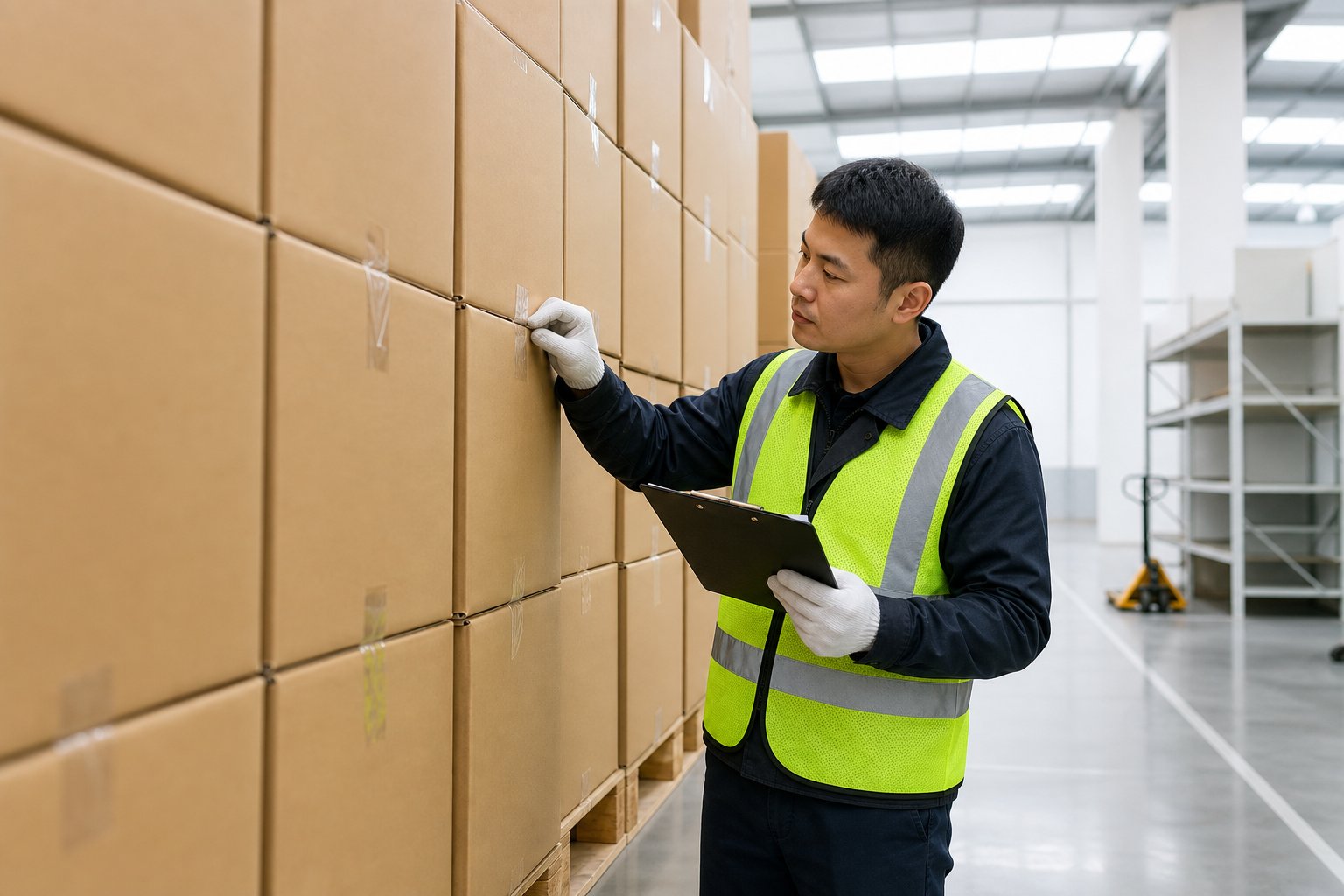
- Packing evidence: packing list plus photos or a short video of loaded cartons, shipping marks and total volume.
- Re-verified payment details, confirmed by voice with your sourcing agent — the discipline our payment safety notice asks for.
- A commercial invoice matching the contract on quantity, unit price, description and Incoterm.
If one of the four is missing, you do not have a payment schedule. You have a hope.
Protect yourself from payment fraud
Payment-redirection fraud is the most expensive mistake in cross-border sourcing, and it almost always starts with an email rather than a bank. Before any transfer, check these:
- Payment details differ from those your sourcing agent provided — the exact case our safety notice covers: stop and contact us for confirmation first.
- The bank account name does not match the company on the contract, or payment is requested to a personal account, a crypto wallet, or an unrelated third country.
- An email — however polished — announces new bank details.
- A discount is offered for moving payment off the confirmed channel.
- The supplier resists putting specifications, MOQ, lead time and tolerances in writing.
- A pre-shipment inspection is refused, postponed, or waved away as unnecessary.
One email to hengfang0001@gmail.com costs nothing; a redirected wire rarely comes back.
Payment structures by order size
- Under USD 3,000: the channel matters less than the discipline — confirm the beneficiary, keep records, and expect bank fees in the USD 20–40 range.
- USD 3,000–20,000: T/T 30/70 with independent inspection before the balance, the standard path for small retailers importing their first mixed container.
- Above USD 20,000: staggered releases with a retention until the forwarder confirms the load, or route payment through your agent so one party holds the inspection lever.
Currency, fees and the paperwork layer
Three quiet costs appear on nearly every settlement. Currency: we settle in USD, so if your account runs on another currency, your bank’s conversion spread applies before the money moves — and a transfer sent in another currency will not match our accounts. Incoterms: they decide who pays freight and duty, not who pays the supplier — DDP especially creates customs liability that payment platforms handle poorly, as we cover in shipping from China: methods, costs and customs. Documentation: a proforma invoice is a quotation; the commercial invoice is the settlement document that must match your customs declaration.
Where a sourcing agent changes the payment equation
A sourcing agent does not remove risk by magic; it changes who holds the pieces. Instead of wiring a factory you have never met, you pay one party that buys domestically in RMB, consolidates several suppliers, inspects before releasing the balance, and ships against a single document set. The agent is also who confirms your payment details and, if you choose that route, creates your Trade Assurance order. See what a China sourcing agent actually does.
FAQ
Which payment methods does Easy Buy China accept?
Two. Wire transfer in USD from any country — bank fees typically USD 20–40 depending on your bank or provider, Wise or Veem available subject to local availability, and bank account details provided by your sourcing agent after order confirmation. And Alibaba Trade Assurance — a 2% additional platform fee, a single payment limit below USD 5,000, and an order your sourcing agent creates once you provide your Alibaba account email.
Can I pay Easy Buy China by credit card, PayPal or letter of credit?
No. Those are market-standard tools used in direct factory contracts, not channels we collect through. Always use the payment details confirmed by your sourcing agent.
What should I do if the payment details I receive differ from what my agent sent?
Stop and confirm before paying — the scenario our payment safety notice addresses. Contact hengfang0001@gmail.com through a channel you already trust.
Can I get my money back if the goods are wrong?
Through a bank transfer, only with the supplier’s cooperation or through legal action that is frequently uneconomic. Through Alibaba Trade Assurance the platform can mediate and refund against documented evidence, if you open the dispute inside the post-delivery inspection window.
The bottom line
Safe payment in China sourcing is a sequence, not a single clever choice: confirm the channel, verify the counterparty, keep the deposit small, tie each release to a verifiable event, and inspect before the balance moves. Buyers who do those things keep their leverage through the whole order.
Ready to place an order? Pay in USD by wire transfer, or ask your sourcing agent to set up an Alibaba Trade Assurance order — both channels, with their current fees and limits, are listed on our payment information page. Questions before you pay? Email hengfang0001@gmail.com. We source from verified suppliers and authorized brand distributors, inspect before release, consolidate orders, and ship to 50+ countries.
评论
3 条对“How to Pay Chinese Suppliers Safely: Wire Transfer, Trade Assurance and the Methods We Don’t Accept”的回复
[…] signal and reconfirm through a channel other than the email that asked for the change. Our guide to paying Chinese suppliers safely covers the payment methods and the interception risk in […]
[…] — or a personal account — is the single most reliable fraud signal in this trade. Our guide to paying Chinese suppliers safely walks through the sequencing, how to verify a Chinese supplier covers the registry and licence […]
[…] be aimed at domestic customers. International buyers should first confirm whether their account, chosen payment method, and supplier support the intended […]